



How are couples using artificial intelligence to find wedding suppliers, and what does it mean for your wedding business? Drawing on our own website data, independent research and what we see every day at Love My Dress, I want to help you understand what’s changing and what you can do about it. We’ll review and update this article regularly as AI search develops, sharing new research and our own findings along the way.
First published: 25th November 2026
Last updated: 25th November 2026
Love My Dress exists because of human creativity. For seventeen years, I’ve had the privilege of documenting and celebrating the work of extraordinarily talented people, many of whom have dedicated their working lives to preserving traditional skills, perfecting their art and creating things of exceptional beauty. I believe profoundly in the value of human artistry and I care about the years of learning, experimentation, patience and personal sacrifice that go into becoming an accomplished photographer, designer, illustrator, florist or maker, the passing of knowledge from one generation to the next and the ability of future generations to make a living through their creative talents.
I cannot adequately express how deeply concerned I am about the use of AI to replace human creativity. The prospect of artists losing their livelihoods to technology trained on the very work they have spent years producing, often without their knowledge or consent, troubles me enormously. So too does the possibility that traditional creative skills could be lost because we’ve become accustomed to prioritising speed, convenience and cost over human endeavour. Earlier this year, I wrote extensively about these concerns in two articles that I would encourage anyone unfamiliar with my position to read:
My personal commitment to authentic human creativity at Love My Dress is absolute. We will never, ever knowingly publish AI-generated wedding photography, bridal fashion campaigns, styled shoots, illustrations or films presented as the creative work of human beings, and we will not fabricate weddings, invent creative work or misrepresent the talents and achievements of the people whose work we feature. Our readers must always be able to trust the authenticity of the wedding inspiration we publish, and that commitment will never change.
I also believe there is value in exploring how artificial intelligence can support independent businesses. I’ve spoken openly about my own use of AI in managing the administrative demands of running a small business, organising information, conducting research and interpreting data, and I’ve found it enormously useful. My interest in AI search is directly connected to my concern for the future of the creative industries. I want the people who make wedding dresses by hand, grow flowers, work with analogue film, practise traditional printing techniques and devote their lives to developing their artistic skills to remain visible and commercially viable as technology changes the way people discover their work.
It’s been a difficult year for many independent wedding businesses. Conversations with photographers, videographers, designers, retailers, florists and other wedding professionals keep returning to the same concerns: fewer enquiries, the diminishing returns of Instagram and real uncertainty about where to invest time and money in marketing. I know so many of us are experiencing AI fatigue too. Some of you may have absolutely no desire to engage with it, whether for ethical reasons or because you’re simply exhausted by the relentless pace of change, and I respect that entirely. But you don’t have to embrace AI, use it in your creative work or spend money on it to understand how online search is changing and what that could mean for your ability to reach new clients, and I’d really encourage you to set aside a little time to do just that.
Couples have long turned to Google, Instagram, Pinterest and independent wedding publications like Love My Dress to discover the businesses they’d love to work with, and they can now also use AI tools such as ChatGPT. Much of what I’m going to recommend within this article costs nothing and requires very little technical knowledge, and I’ve included practical examples, links to useful resources and suggested wording for messages to your website developer where you might need some technical help.
This is a long read, so if you’ve only got ten minutes today, here’s a TLDR list of three basic things you can do straight away to help your business be more visible to couples using AI to plan and research for thei wedding:
- Open a private browser window, go to ChatGPT without signing in and ask it to recommend businesses like yours, then ask about your own business by name. See what it knows about you, whether it’s accurate and which websites it has drawn on.
- Read your website as though you’ve never encountered your business before. Is it immediately clear what you do, where you work and what you specialise in?
- Add two questions to your enquiry form: ‘Where did you first discover our business?’ and ‘Was there anything in particular that encouraged you to get in touch?’
I’ve also put together a comprehensive checklist at the end of this article, which you might like to bookmark and return to whenever you have some time to work on marketing your business.
How might a couple discover your wedding business online today?
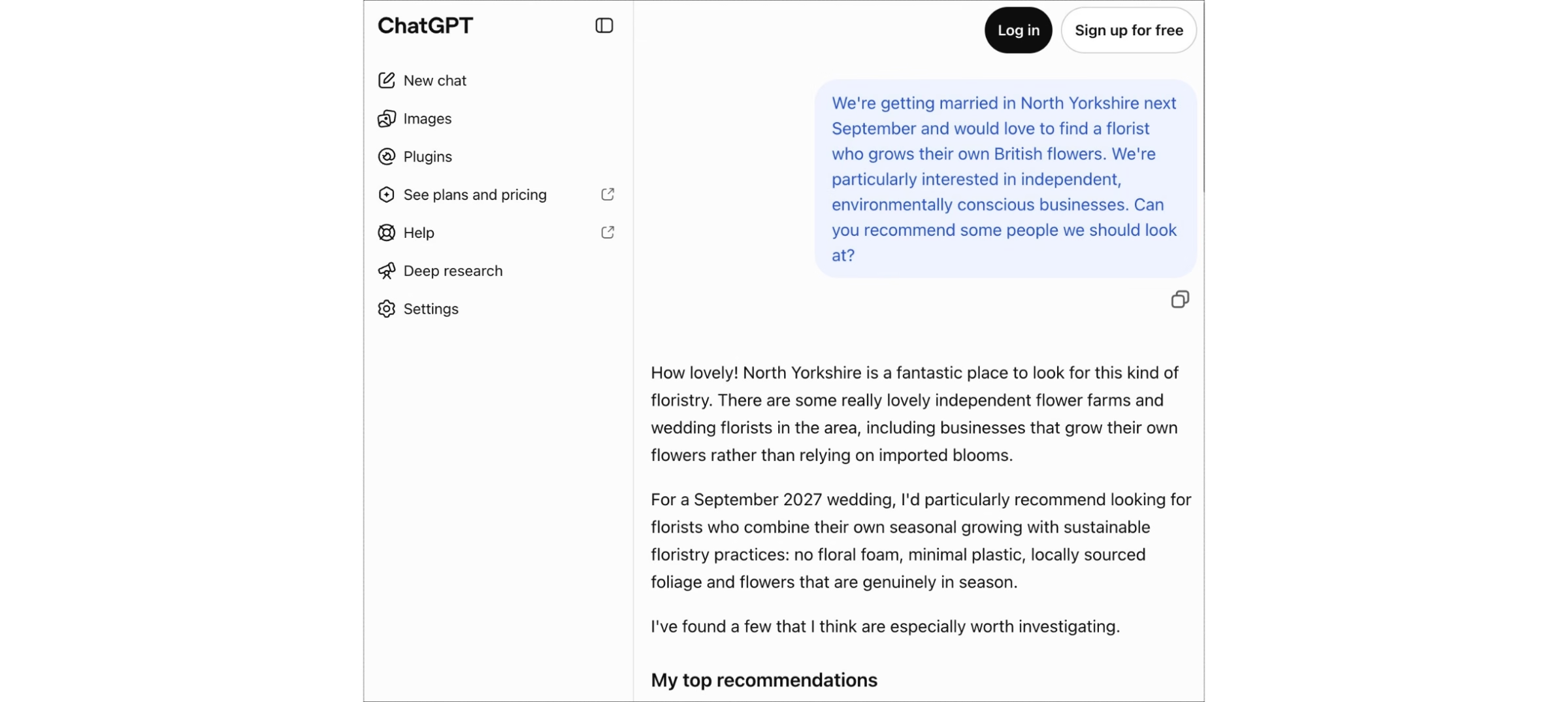
Imagine you’re getting married in Yorkshire and looking for a florist. You love seasonal British flowers, would prefer to work with someone who grows their own and have a particular budget in mind. You might search Google, browse Instagram, look through real weddings on Love My Dress or ask your venue for recommendations. But you could also open ChatGPT and type something like this:
“We’re getting married in North Yorkshire next September and would love to find a florist who grows their own British flowers. We’re particularly interested in independent, environmentally conscious businesses. Can you recommend some people we should look at?”
ChatGPT can search the internet, suggest businesses and provide links to websites where it has found relevant information. You can then ask follow-up questions about those businesses, compare what they offer and refine your search, all within the same conversation. Other AI tools, including Google Gemini, Claude and Perplexity, offer similar capabilities when using web search.
This is an important development for wedding professionals because a couple may already have learnt quite a lot about your business before they ever visit your website. They might have found you through an AI recommendation drawing on a real wedding feature, a directory listing or a venue’s website, without ever visiting any of those websites themselves.
We don’t yet know how widespread this is amongst couples planning weddings and I certainly wouldn’t blame the recent downturn in enquiries on AI alone. But we do have evidence that people are already finding wedding content this way.
We’re getting married in North Yorkshire next September and would love to find a florist who grows their own British flowers. We’re particularly interested in independent, environmentally conscious businesses. Can you recommend some people we should look at?
What we’re seeing at Love My Dress
One of the advantages of running a wedding publication like Love My Dress is being able to see how people discover our content and what they’re interested in reading. In the twelve months ending 27th October 2026, Love My Dress recorded 803,000 active website users and 1.39 million page views. With over 7,600 articles and features, I’m particularly interested in how AI is helping people discover our extensive archive of wedding content.
In the 28 days ending 24th November 2026, our Google Analytics data recorded 760 visits from identifiable AI sources, measured as sessions, 737 of which came from ChatGPT. My inner tech-nerd finds the insights this provides fascinating; features we published between 2010 and 2015 are being discovered through technology that didn’t even exist when we wrote them and our wedding readings are proving especially popular. Until recently however, we could only really see the activity of people who actually clicked through to our website. What about all those conversations taking place within ChatGPT where Love My Dress might be referenced, but the person asking the question never visits us?
On 10th November 2026, OpenAI began rolling out Businesses in ChatGPT, managed through a free dashboard called Business Hub. It’s free for eligible businesses and allows owners to claim their business profile and access information about how they’re being discovered through ChatGPT. I’ll explain how you can check whether your own business is eligible shortly.
Naturally, I was keen to explore this and having verified Love My Dress, I was able to see that over the same 28-day period, ChatGPT had recorded:
- 2,949 mentions of the Love My Dress website within its answers.
- 587 clicks through to our website from ChatGPT.
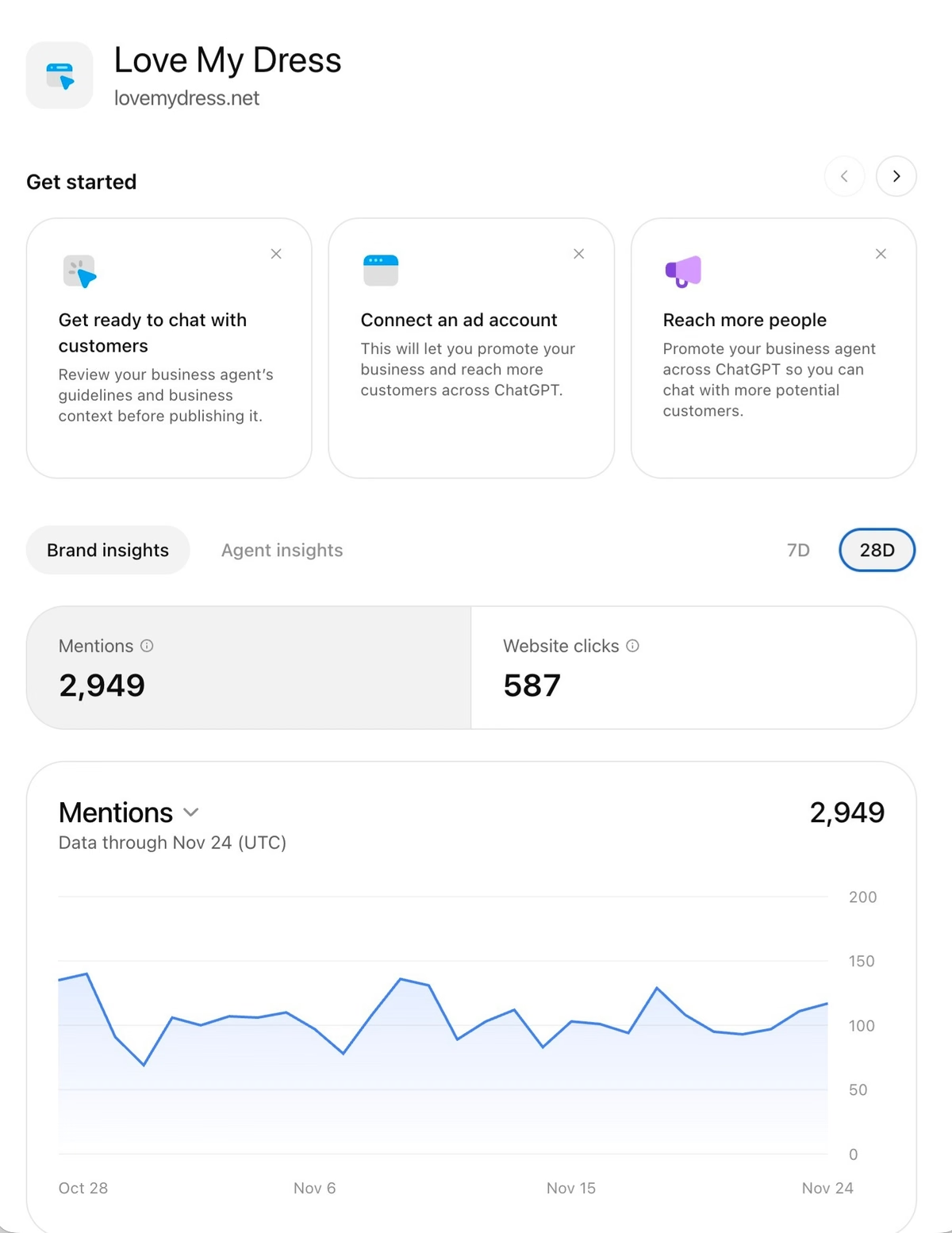
what our chatgpt business hub dashboard looks like
Business Hub also provides some insight into the subjects people are researching when they come across us, although this is an area where I’d love to see more detailed reporting. Around 78% of the mentions in our discovery topics report are currently grouped under ‘Other’, making it difficult to establish how much of this activity relates specifically to wedding planning and supplier discovery. What would be especially helpful to me is knowing how many couples have found their wedding photographer, florist or dress designer through AI drawing on something we’ve published on Love My Dress, without ever visiting our website.
To explain that in a little more detail: imagine a couple asking ChatGPT to recommend a wedding photographer in East Scotland. ChatGPT might find information about a particular photographer within a wedding we’ve published, use that information to inform its recommendation and direct the couple straight to the photographer’s own website. That couple may never visit Love My Dress or even be aware of the part we played in helping them discover their photographer.
At present, we have no reliable way of measuring how often this happens. But it does introduce another dimension to the value of editorial coverage. Every real wedding, editorial feature and directory listing published about your business provides another source of information that AI search tools can potentially draw on when making recommendations to couples.
Whilst we’ve traditionally looked at website visits, referral traffic and enquiries to understand the value of editorial coverage, we may increasingly need to consider its influence on couples’ decisions even when they never visit the publication itself. Its potential value now extends beyond the people who actually read it.
Have you claimed your business on ChatGPT?
You’re probably familiar with Google Business Profiles, the information panels that appear when you search Google for a local shop, restaurant or venue. As I mentioned above, OpenAI has introduced something similar called Businesses in ChatGPT, which lets eligible business owners claim their business, review and update its profile information and see some figures about how often their business appears in ChatGPT.
To get started, visit the Businesses in ChatGPT website and follow the instructions to check whether your business is eligible.
You’ll need to verify your ownership of the business before you can access the information available to you. When I did this very recently for Love My Dress, I was asked to provide a copy of government-issued ID and chose to use my driving licence – and yes I recognise the absurdity of me having to prove to an AI company that I’m a real person, but it was quick and relatively painless. The whole process didn’t take long at all, although the verification options may vary depending on your business.
Depending on the information available, you may then be able to see how often your business is mentioned, how many people click through to your website and the kinds of subjects people were asking about when they came across you. It’s free (for now?), although the service is still developing and not every business is currently eligible. Smaller businesses may also find there isn’t yet enough activity for some figures to appear.
Claiming your business won’t guarantee that ChatGPT recommends you more often, but it does give you an opportunity to review and correct the business information held in your profile.
What is a ChatGPT Business Agent?
Within Business Hub, eligible businesses can also create their own Business Agent. Think of this as an AI-powered customer service assistant for your business, which people can speak to within ChatGPT. You provide the agent with information about your business, your services and your policies, together with instructions about how you’d like it to respond to questions. When ChatGPT mentions your business in a conversation, a couple can then choose to ask your agent questions directly. Business Agents are clearly identified as AI assistants representing a particular business, and their conversations are kept separate from ChatGPT’s own independent recommendations.
For example, a bridal boutique might create an agent that can answer questions about the designers it stocks, its price ranges, how bridal appointments work and whether alterations are available. A customer could ask several questions about the boutique before deciding whether to visit its website or arrange an appointment.
If you’re eligible to create one, you’ll find the option within your Business Hub, where you can provide information, set instructions, test how your agent responds and make adjustments before publishing it. I’d be particularly meticulous about testing the accuracy of its answers and making sure it knows when to direct somebody to your website or encourage them to contact you personally. I’d never want an automated assistant to give incorrect information about pricing, availability or the services a business offers.
Creating a Business Agent is entirely optional, and you don’t need one for your wedding business to appear in ChatGPT’s search results. OpenAI is still rolling it out, and eligibility currently depends on where you’re based and the type of business you run. You can read more about setting up your business and creating a Business Agent here.
And by the way, if the idea of an AI assistant speaking on your behalf makes you feel like throwing your laptop through the window, you’re certainly not alone, and there’s no obligation whatsoever to create one.
AI is also changing Google
You may have noticed that when you search Google, an answer sometimes appears at the top of the page, summarising information from several websites. These are called AI Overviews. Google also offers AI Mode, which lets you ask more detailed questions and keep researching a subject through conversation. Couples don’t need to visit ChatGPT or another dedicated AI tool to use AI search because it’s already part of Google.
Google has confirmed that the work businesses have traditionally done to help their websites appear in Google, often called SEO (search engine optimisation), remains relevant. So don’t panic, because there’s no need to assume your website needs rebuilding for AI.
Google has published its own guidance on appearing in AI search results, which is useful to share with your website developer if you’re thinking about making changes.
Beautiful websites that tell us surprisingly little
Part of my work involves reviewing the websites of wedding businesses applying to join the Love My Dress directory. I’ll often find a photographer whose portfolio I absolutely love but struggle to work out where they’re based, or look through photographs of exquisite wedding dresses by an independent designer and learn very little about where they’re made, the fabrics used or what it would be like to commission one. Often, the most interesting things about these businesses only emerge when I start talking to their owners.
My husband and I run an independent floristry business, Moonwind Flowers, in North Yorkshire. He grows flowers on our own land and works with the British growing season. For a couple specifically looking for a florist who grows their own flowers, that could be the very thing that persuades them to get in touch. If we never mentioned it on our website, though, an AI tool might struggle to work out that we offer exactly what that couple is looking for.
So take a little time to read through your own website as though you were a potential client who knew nothing about you. Is it clear where you’re based and how far you’re prepared to travel? Have you explained what you specialise in, how long you’ve been doing it, which venues you’ve worked at and what’s distinctive about your work? Perhaps you have years of experience photographing Jewish weddings, specialise in wedding dresses for older brides or offer a particularly thoughtful service to neurodivergent couples.
Perhaps you use traditional techniques that are becoming increasingly rare, source your materials from specialist British manufacturers or undertake every stage of production by hand in your own studio. These are things that matter enormously to some couples when choosing the businesses they want to work with. Make sure that information is available to the people researching you.
You needn’t compromise the beauty of your website to do it. Sometimes a few well-written paragraphs are all that’s missing.
Write about the things you know
Our industry is full of people with specialist knowledge that rarely makes its way onto their websites. For example, a photographer who has worked at a particular venue many times knows where the light is best at different times of day. A bridal designer can explain how different silks feel and behave when worn. A florist can tell couples which flowers are likely to be available for an autumn wedding.
These are things people planning weddings really want to know and they’re things you could be writing about on your website.
If you’re wondering where to begin, look through your recent enquiries. What do couples ask you again and again? Perhaps you’re a stationer whose clients often ask about the difference between letterpress and digital printing, or a planner regularly advising on the practicalities of marrying abroad.
Write something useful that answers it. You already have the knowledge, so there’s no need to research unfamiliar subjects or produce long articles every week. A handful of thoughtful pieces could keep helping couples find and understand your business for years. And if writing doesn’t come naturally to you, try recording yourself on your phone answering the question as though a couple had asked it over coffee, then write it up from there. You’ll be surprised by how much you already know.
Please don’t feel that you need to start generating articles with AI to improve your online visibility. Google itself warns against publishing large amounts of content primarily to manipulate search results or AI answers. The knowledge you’ve accumulated through years of working with real materials, real people and real weddings is enormously valuable. I’d encourage you to share more of it, in your own words, through your website.
What other websites say about you
When an AI tool researches your business, it may find information about you on several different websites. Your own website explains what you do, whilst a real wedding feature on a site like Love My Dress shows your work, names the venue and describes the couple’s experience. A venue’s recommended supplier list provides another professional recommendation and a client review explains what someone particularly appreciated about you. Together, these provide a fuller picture of your business.
This is something I’ve thought about a great deal through running the Love My Dress directory, which is a paid membership service, alongside our editorial pages. When we publish a real wedding, we’re documenting the work of numerous wedding professionals. Those features stay online for years, giving couples and search tools another source of information about the businesses involved. There’s no guarantee that being featured or joining a directory will lead to AI recommendations, but having your work documented beyond your own website provides more opportunities for people to discover you.
If you already have directory listings, take a few minutes to read through them. Are the photographs still representative of your work? Have you added new services or developed specialist experience since the listing was created? Have your contact details or the areas you cover changed?
You’re already investing in those listings, so make sure they’re representing you well.
I’ve written more about this in an earlier article on the value of wedding directory listings in the age of AI.
Can couples find you through AI if you’ve blocked AI from your website?
Given my position on the use of AI to replace human creativity, this is something I have been particularly keen to understand. I know many photographers, designers and other creatives are uncomfortable with the idea of their work being used to train AI models. Some have already taken steps to restrict AI companies from accessing their websites.
Allowing an AI tool to find information about your business when someone searches for a wedding supplier is not necessarily the same as allowing that company to collect your creative work for AI training. Some companies use separate systems for these two purposes. OpenAI, for example, uses something called GPTBot to collect website content for potential AI training and a separate system called OAI-SearchBot to find website content for ChatGPT search. It’s possible to restrict the first whilst allowing the second.
Google also offers separate controls for how website content is used in certain AI products and whether it appears in Google’s AI search features. These settings give you some choices about how your website content is accessed and used. They cannot, however, guarantee that your work has never been used for AI training or prevent somebody from obtaining it elsewhere. If your eyes glazed over somewhere around “OAI-SearchBot”, you’re in most excellent company my friend – and that’s exactly what the message below is for.
Whether you’re comfortable allowing AI search tools to access your website is ultimately a decision for you. I would encourage you to understand the options available before making that decision. If you’re unsure about your current website settings, you could send your website developer a message along these lines:
“I’d like to understand whether my business can currently be found through AI search. I’m uncomfortable with the idea of my creative work being collected for AI training, so could you check my website settings and explain what options I have for restricting that whilst remaining discoverable through AI search?”
You can also share these official guides with them:
Your website developer should be able to explain what these settings mean for your particular website.
Before you spend money on AI optimisation
There’s a growing market for services promising to make businesses more visible in AI search. You may come across the terms GEO and AEO (Generative Engine Optimisation and Answer Engine Optimisation), both broadly concerned with helping businesses appear in AI-generated answers. Some people are doing interesting research in this area, but there’s still a great deal nobody fully understands about how each AI tool decides which businesses to recommend.
Google has confirmed that businesses don’t need to create special files for AI, add new technical code specifically for AI search or break their writing into short chunks to appear in its AI search features. That doesn’t mean your website couldn’t benefit from professional help, but please don’t feel pressured into spending money because someone tells you your business will become invisible without their service.
If you’re considering paying for professional help, ask three questions:
- What exactly will you do to my website or online presence?
- Why do you believe this will help my particular business?
- How will you show me whether the work has made a difference?
Nobody can guarantee that ChatGPT, Gemini or any other AI tool will recommend you.



Find out what AI says about your wedding business
Here’s something you can try yourself and it needn’t cost you anything but a little time. Open a private or incognito browser window and visit ChatGPT, Google Gemini, Claude or Perplexity. If possible, use the service without signing in. If you need to sign in, start a new conversation with personalisation switched off where the service allows it. This helps reduce the influence of information you’ve previously shared about your business, although it won’t eliminate every factor that may affect the answers. Turn on web search if the platform offers that option.
Then imagine you’re a couple looking for someone who provides your services and ask the kind of question they might.
For example:
- Can you recommend independent bridal boutiques in London stocking contemporary British wedding dress designers?
- Which wedding photographers in Scotland work with analogue film?
- Can you recommend Yorkshire wedding florists who grow their own flowers?
- Where can I commission handmade letterpress wedding stationery in Britain?
- Which independent bridal designers in the UK make bespoke wedding dresses by hand?
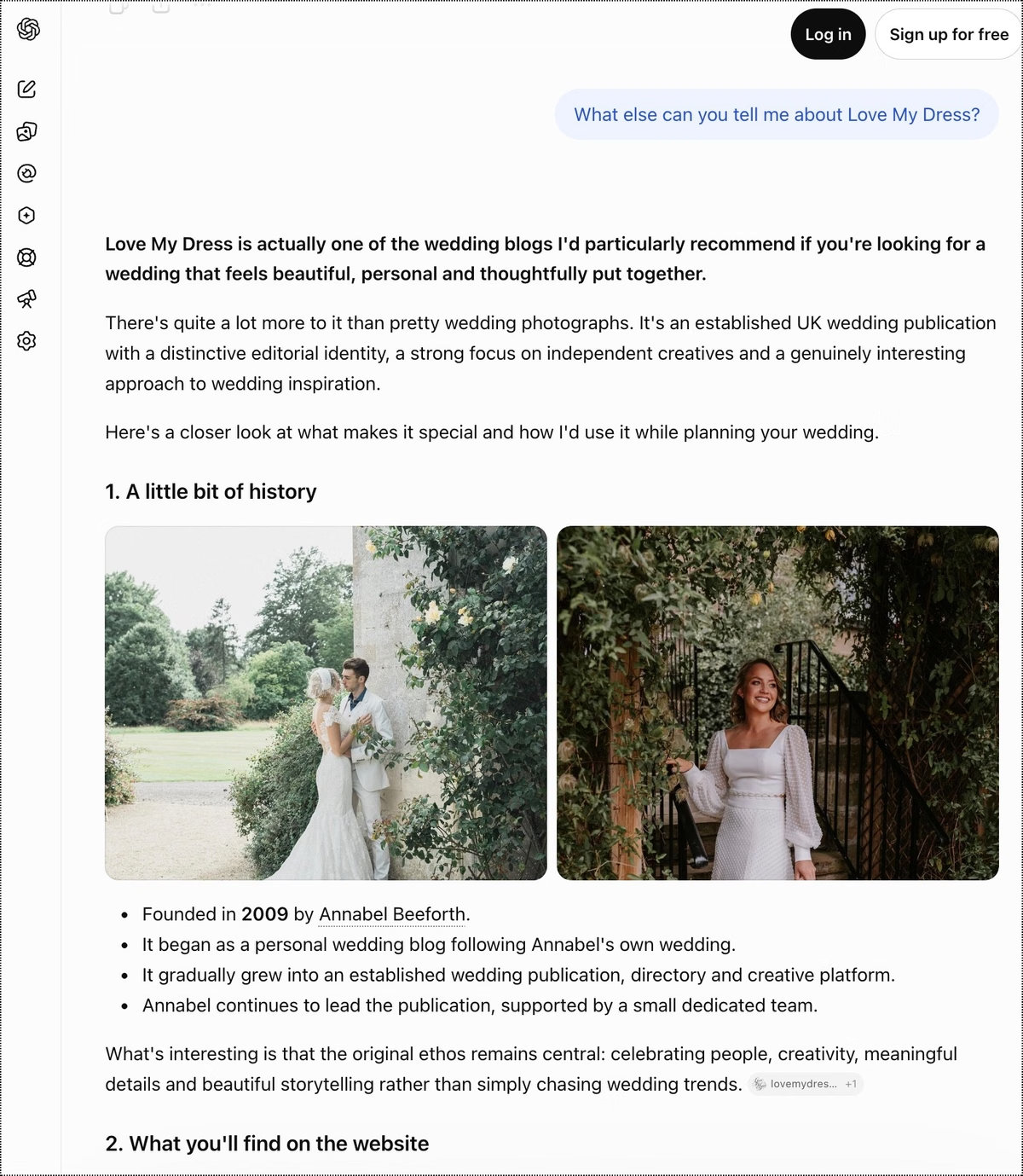
When I opened ChatGPT without signing in and asked it, as a couple might, to recommend wedding blogs to follow while planning a wedding, Love My Dress was its first suggestion. It’s only one search, and results vary from one conversation to the next, but it was a lovely thing to see!
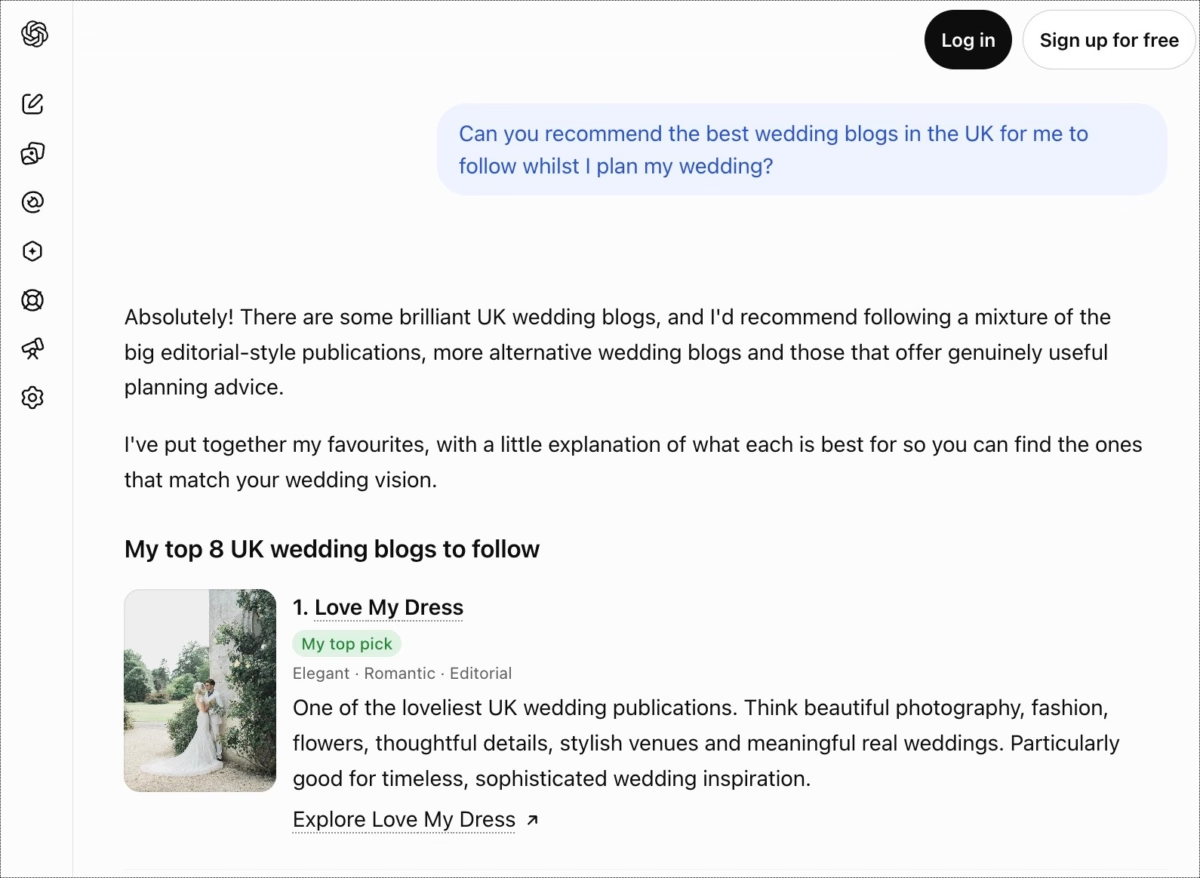
Don’t mention your business name at first. See which businesses are recommended and look at the websites the answer has drawn on. You may discover publications, directories or other sources of information that you hadn’t previously considered. Then ask about your own business directly. Does it describe your services accurately? Does it know where you’re based? Has it understood what you specialise in? Is it using outdated information?
If you notice inaccuracies, look at your own website and any other websites mentioned in the answer. You may discover information that needs updating or important details about your business that you’ve never actually published anywhere.
Remember that AI answers can change from one conversation to the next and can contain mistakes. Being missing from one answer doesn’t mean you’re invisible, just as appearing once doesn’t mean you’ll always be recommended.
Keep a simple note of the questions you asked, the date and what you found. Try the same questions again in a month or two, using similar settings.
Some wedding professionals are also developing technology specifically for our industry. Wedding filmmaker Arran Kenny, a member of our directory, has created WedSearch, a subscription-based service that helps wedding businesses explore and monitor their visibility across ChatGPT, Gemini and Perplexity by running test searches over time. Tools like this can help you notice changes, though test searches can’t tell you how often real couples are being recommended your business or whether those recommendations are leading to bookings. (For transparency, Love My Dress has no commercial arrangement with WedSearch.)
Is AI already sending people to your website?
You may have Google Analytics on your website, a free Google service that shows how many people visit and where they’ve come from. If someone else built your website, they may already have set it up for you.
Since May 2026, Google Analytics has had a category called AI Assistant, which makes it easier to see visits from tools such as ChatGPT.
If you’d like to check yourself:
- Sign in to Google Analytics.
- Select your website.
- Click Reports.
- Open Acquisition (it may sit under a heading called Life cycle), then Traffic acquisition.
- Look for AI Assistant in the list of traffic sources.
If it’s there, you’ll see how many website visits, recorded as sessions, Google Analytics has attributed to AI tools over the dates you’ve chosen.
It won’t give you the complete picture, as some AI visits may be sorted into other categories. Visits from Google’s own AI Overviews and AI Mode are not separately identified from other Google search traffic in standard Google Analytics reports.
There’s also a free service called Google Search Console, which helps website owners understand how their websites appear in Google’s search results. Google has introduced a report showing how often links to your website appear in its AI search features. Your website may not yet have enough activity for this report to be available.
If the words Google Analytics make your heart sink a little, please don’t worry, as this is precisely what your website developer is there for. You could simply send them this:
“Hey! Could you kindly check whether I have Google Analytics and Google Search Console set up for my website? I’d love to find out whether people are already visiting my website from ChatGPT or other AI tools, whether Google’s AI search report is available for my website and how I can check these figures myself in future. Thanks so much.”
Once you know where to look, make a note of the figures each month. This will help you understand whether the amount of identifiable AI search traffic you’re receiving is changing over time.
Bear in mind that these figures only tell you about visits and appearances that the reporting tools can identify. They won’t tell you every time an AI tool recommends your business or influences someone’s decision to get in touch.
Ask your couples two simple questions
Most wedding businesses ask prospective clients how they heard about them, but I wonder whether we could be asking better questions. I’d love to see more wedding professionals adding these two to their enquiry forms:
- Where did you first discover our business?
- Was there anything in particular that encouraged you to get in touch?
A couple might first discover a designer through a real wedding on Love My Dress, follow their work on Instagram for eighteen months and eventually ask ChatGPT about them before booking an appointment. If they simply tick Instagram on the enquiry form, the part the other two played may never come to light.
I’d also encourage you to include ChatGPT or other AI search tools amongst the options if your enquiry form already provides a list of places where couples might have discovered you. Ideally, give them the opportunity to select more than one answer or provide a little additional information in their own words.
Understanding more about how couples discover and research your business can help you make much better decisions about where your marketing budget goes.
Please don’t abandon everything else in favour of AI
I have a complicated relationship with Instagram these days. I’m grateful for the opportunities it has brought my businesses but increasingly uncomfortable with the amount of time and creative energy we’re expected to give it. I suspect many of you feel much the same.
However frustrated you are with it, though, I wouldn’t abandon an established source of enquiries in the hope that AI will replace it. Couples will continue asking friends for recommendations, trusting the judgement of their wedding planners, falling in love with photographs on Pinterest and discovering designers through wedding publications.
I’d much rather see independent wedding businesses invest in a good website of their own, maintain meaningful relationships within the industry and develop several different ways of being found than become overly dependent on yet another technology company.
And I certainly wouldn’t compromise the integrity of your creative work or spend money you can ill afford simply because you feel under pressure to keep up with AI.
Your AI Search Checklist
Most of these suggestions won’t cost you anything, and there’s no need to do them all at once. Tick off one or two when you have a quiet moment, and be kind to yourself about the rest.
Things you can do yourself
☐Read your website as a stranger would. Could someone who knows nothing about you tell, within a minute, what you do, where you’re based, how far you travel and what makes your work different? If not, a few well-written paragraphs may be all that’s missing.
☐Ask AI to recommend businesses like yours. Open a private or incognito browser window and visit ChatGPT or Google Gemini. Use the service without signing in where possible, or switch off personalisation if you need to sign in. Enable web search if available. Ask the kind of question a couple might, such as ‘Can you recommend wedding florists in Yorkshire who grow their own flowers?’ Note who is recommended and which websites the answer draws on.
☐Ask AI about your own business. Using the same settings, ask what it knows about your business by name. Check whether it describes where you’re based, what you specialise in and what you offer correctly. Keep a note of what you find and try again in a month or two. Remember that answers can change from one conversation to the next and may contain mistakes.
☐Check your profiles and listings. Review your Google Business Profile and any wedding directory listings you have. Are the photographs, services, areas covered and contact details all up to date?
☐Check whether you can claim your business in ChatGPT. It’s free for eligible businesses. Visit the Businesses in ChatGPT website and follow the instructions to check your eligibility and verify your ownership. Claiming won’t guarantee recommendations, but it lets you review and correct your business profile.
☐Add two questions to your enquiry form. ‘Where did you first discover our business?’ and ‘Was there anything in particular that encouraged you to get in touch?’ Include AI search amongst the possible answers if you provide a list of options.
☐Write one useful article. Think of a question couples ask you regularly and answer it properly on your website, in your own words. Draw on your professional knowledge and experience.
☐Get your work seen beyond your own website. Submit real weddings to publications whose values you share, invite past clients to leave honest, detailed reviews and ask venues you’ve worked with whether you could be included on their recommended supplier list.
☐Ask three questions before paying for any AI optimisation service. What exactly will you do, why do you believe it will help my business and how will you show me whether it’s worked?
☐Review your marketing expenditure. Consider where your enquiries currently come from and whether you’re relying too heavily on any one platform. Don’t abandon an established source of business without good reason.
Things to ask your website developer
☐Check your AI settings. Send them this: ‘Can you check whether AI search tools, including ChatGPT, can find my website? I’d also like to understand my options if I want to restrict access to my website content for AI training.’
☐Check where your website visitors come from. Send them this: ‘Could you check whether I have Google Analytics and Google Search Console set up for my website? I’d love to know how to see visits from ChatGPT and other AI tools and whether Google’s AI search report is available for my website.’
A final thought
You made it to the end! Pat yourself on the back pal!
But let’s be serious for a moment, because I think it’s entirely natural to have very big feelings about AI right now. We’re living through an extraordinary period of technological change, and the speed at which it’s happening leaves very little time to process any of it. There are profound questions about the future of human creativity, employment, education, the environment and the kind of world our children will inherit, and I find some of what we’re witnessing deeply unsettling. Finding AI useful in certain areas of our lives doesn’t invalidate our concerns about its use in others, and I don’t think any of us has to take an absolute position for or against the technology in its entirety. We can keep asking difficult questions and keep learning.
Much of what I’ve shared in this article comes from wanting to understand how we can safeguard the future of independent creative businesses in a world that’s changing at a pace none of us could have anticipated. I’ll continue researching this subject and sharing what I learn through our Business and Industry pages, and I’d love to hear from wedding professionals who have started receiving enquiries from couples who discovered them through AI search. I think there’s a great deal we can learn from one another.
With love,
Annabel x
If you’re a Love My Dress directory member, please do take some time to revisit your listing in light of this article. If you’d prefer us to review and update it on your behalf, just get in touch. We’d also love to hear from you if you have specialist knowledge, industry insights or an opinion you’d like to share with our readers. We’re always keen to champion the expertise within our community through editorial features, educational articles and thought-provoking opinion pieces. If you’d like to join us, you’ll find all the details here.